Showing posts with label Animal. Show all posts

Monday, November 15, 2010

The World's Biggest Stuff


The World's Biggest Stuff

Castle

The largest ancient castle in the world is Prague Castle in Prague. Built in the ninth century, it is an oblong irregular polygon with an average diameter of 420 feet and a total surface area of 18 acres. At times, it has housed the kings of Bohemia as well as Holy Roman emperors and presidents of Czechoslovakia. After Czechoslovakia split into the Czech Republic and Slovakia in 1993, the castle became the seat of the head of state of the new Czech Republic.

Animal

Blue whales, on average, weigh 176 tons. Their tongues alone are as heavy as an elephant. They reach these behemoth proportions on a diet of tiny shrimplike animals called krill. Blue whales were hunted almost to extinction but are now on the International Union for Conservation of Nature’s list of endangered species. They live in all the world’s oceans, but travelers who wish to spot these rare creatures might try a whale-watching cruise in the Gulf of Maine, which runs from Massachusetts to Nova Scotia. Visitors to Santa Catalina Island, Calif., can try to see them from December to March. Car ferries crossing the Bay of Biscay (north of Spain and west of France) often pass these animals, and Iceland also offers blue-whale-watching tours.

Skyscraper

Dubai, United Arab Emirates, opened the world’s tallest skyscraper in January, and superlatives have poured in ever since. If you stuck the Eiffel Tower on top of the Empire State Building, you still wouldn’t have a structure as tall as the Burj Khalifa. It rises 2,717 feet from the desert and provides views of the Persian Gulf, the sail-shaped Burj al-Arab hotel and the manmade Palm Jumeirah island. Originally named Burj Dubai, the building was renamed in honor of Sheik Khalifa bin Zayed Al Nahyan, the ruler of Abu Dhabi, which pumped tens of billions of dollars into Dubai last year as it struggled to pay enormous debts. Burj Khalifa also plans to have the world's highest mosque and swimming pool.

Cruise Ship

Royal Caribbean’s Oasis of the Seas debuted in December as the world’s largest cruise ship. It’s nearly five times the gross tonnage of the Titanic, 1½ times longer than the U.S. Capitol building, has 16 decks and has a capacity for 6,296 guests. At 1,187 feet long, 208 feet wide and 213 feet in air draft, it’s too long, too wide and too tall to fit through the Panama Canal.

Coral Reef

The Great Barrier Reef off Queensland, Australia, is so large that it can be seen from space. It is 1,260 miles long and home to thousands of separate reefs. It’s a breeding area for humpback whales as well as six species of sea turtles, including the endangered green sea turtle. About 125 species of shark, stingrays, skates and chimera live on the reef. Swimmers, snorkelers and divers beware: It’s home to dangerous creatures, too, including the box jellyfish (which can inflict a fatal sting on humans), the blue-ringed octopus (whose venom can kill an adult human in minutes) and 15 species of sea snakes (all of which are lethal).

LED Project

Abu Dhabi, United Arab Emirates, just became home to the world's largest LED project. The Yas Hotel looks like something out of a science fiction movie or, in the words of the hotel, “a giant fishing net tossed over the sea.” The eye-catching hotel is wrapped in 5,000 LED lights that can change colors and even display video. The hotel has several restaurants, a spa, two rooftop swimming pools and access to an 18-hole golf course on Yas Island.

Swimming Pool

The world’s largest swimming pool is the San Alfonso del Mar seawater pool in Algarrobo, Chile. It is 3,324 feet long, longer than 20 Olympic-sized swimming pools laid end to end. Water from the neighboring Pacific Ocean is heated to a comfortable 79 degrees Fahrenheit for swimming. Sports enthusiasts can sign up for classes in swimming, sailing, kayaking and scuba diving.

Tree

Trees invite superlatives. The world’s biggest tree is General Sherman, a giant sequoia that’s 275 feet high with a trunk volume of about 1,487 cubic meters. You’ll find it in Giant Forest within Sequoia National Park east of Visalia, Calif. General Sherman is believed to be between 2,300 and 2,700 years old.

Indoor Water Park

The Tropical Islands Resort near Berlin is the largest indoor water park in the world. It’s housed inside a giant former blimp hangar and is 1,181 feet long and 689 feet wide. It contains an artificial rain forest, a tropical village, white sand beaches, a Balinese lagoon, an artificial sea and Germany's highest water slide. Visitors can take in the big picture by dangling in a chair beneath a giant helium balloon. The sauna and spa complex offers traditional massage, Thai massage and something called a “hot chocolate massage.” If you’re smitten with the faux tropics, you can also choose to spend the night here in a tropical island lodge or a tent in a rain forest camp.

Mountain

Mount Everest, 29,029 feet, is the world’s highest mountain. In 1953, New Zealand’s Edmund Hillary and Nepal’s Tenzing Norgay were the first to reach the summit. Mount Everest has claimed the lives of 133 mountain climbers, including eight who died in the 1996 Everest disaster documented in Jon Krakauer’s book “Into Thin Air.” The oldest person to climb Mount Everest was Min Bahadur Sherchan of Nepal, who summited at the age of 76 years and 340 days.

Shopping Mall

The New South China Mall in Dongguan, outside of Guangzhou, China, boasts 7.1 million square feet in gross leasable space, making it twice the size of the Mall of America in Minnesota. The Guangzhou mall has a roller coaster, canals, lakes and room for more than 1,500 stores. Trouble is, since its opening in 2005, it has stood nearly empty. Its spectacular failure has been blamed on lack of infrastucture including no local airport, and being out of tune with a local economy that has 1 million locals and 5 million poorly paid migrant laborers. Dongguan, which is dominated by the export industry, suffered even further with the global economic downturn.

Desert

By definition, a desert is a region that receives almost no precipitation. Surprisingly, Antarctica qualifies, as it receives annual precipitation of only 8 inches along the coast, and far less inland. Antarctica rolls on for more than 5.3 million square miles, making it a larger desert than the Sahara, the Arabian Desert or the Gobi Desert. Of course, if it’s heat you seek, the Sahara in North Africa is the largest hot desert in the world. At its greatest length, it stretches 3,200 miles from east to west.

Aquarium

Georgia Aquarium in Atlanta, which opened in 2005, is the world’s largest, with 8 million gallons of water. It contains the largest collection of giant groupers, potato groupers, humphead wrasses, tarpons, giant trevallies, batfish, sawfish, blacktip reef sharks, giant hammerhead sharks and wobbegong sharks in an aquarium.  It’s also the only aquarium outside of Asia to house whale sharks, the world’s largest fish. You can swim or scuba dive with these whale sharks as part of the aquarium’s programs. The swim program allows participants to swim at the surface with an air supply, which does not require any certification.

National Park

Northeast Greenland National Park is the largest national park in the world, with an area of 375,000 square miles. It is therefore larger than 163 countries. It’s the only national park in Greenland, as well as the most northerly national park in the world. Visitors will find virtually no humans but can look for polar bears, musk oxen, walruses and five species of seals. Narwhals migrate into the fjords in summer. The park is north of the Arctic Circle, so the aurora borealis can be observed almost year-round, but the best times are from October to early April.

Roller Coaster

Kingda Ka roller coaster at Six Flags Great Adventure in Jackson, N.J., is the tallest and fastest roller coaster in the world. The train climbs to 456 feet and can accelerate to 128 mph in 3.5 seconds. The thrill ride travels 3,118 feet and lasts 59 seconds.

Waterfall

Angel Falls in Canaima National Park, Venezuela, is the highest waterfall in the world. It has a total drop of 3,212 feet, which makes it higher than Burj Khalifa, the world’s tallest skyscraper (which is 2,717 feet). Angel Falls was named after the U.S. pilot Jimmie Angel, who recorded it in his log book in 1933. If you’re wondering where to find the largest waterfall in the world, head to Boyoma Falls in the Democratic Republic of the Congo. It flows at a rate of 600,000 feet per second.

Tropical Rain Forest

The Amazon rain forest encompasses 1.7 billion acres and stretches across Brazil, Peru, Colombia, Venezuela, Ecuador, Bolivia, Guyana, Suriname and French Guiana. It is, however, shrinking at an alarming rate. National Geographic magazine reports that close to 20 percent of the Amazon has been cut down in the last 40 years. The Amazon has the world’s richest diversity of birds, freshwater fish and butterflies and is home to jaguars, pink dolphins, howler monkeys, southern two-toed sloths, poison dart frogs and scarlet macaws.

Active Geyser

Steamboat Geyser in Yellowstone National Park's Norris Geyser Basin is the world's tallest active geyser. During major eruptions, it throws water more than 300 feet in the air. The geyser has gone through periods of activity and dormancy. It has erupted as frequently as every four days and as infrequently as every 50 years. When it does happen, though, you’ll know it. Conversation becomes nearly impossible next to the geyser. Mature lodgepole pines have been broken by the blast, stripped of their limbs by the weight of ice from the water and steam of winter activity, and undermined and then washed away by the geyser’s massive discharge.

Restaurant

The Bawabet Dimashq, also known as the Damascus Gate restaurant, in Damascus, Syria, is the largest in the world, with 6,014 seats. What’s on the menu? Just about everything. The huge restaurant complex has six culinary themed sections for Indian, Chinese, Arab, Iranian, Middle Eastern and Syrian cuisine. Local specialties include lamb with thyme, steak with yogurt and beans, tabbouleh, hummus and baba ghanoush. During busy summer months, the restaurant employs up to 1,800 people in the dining area and kitchen.

Monday, November 1, 2010

Dogs as Tarantulas

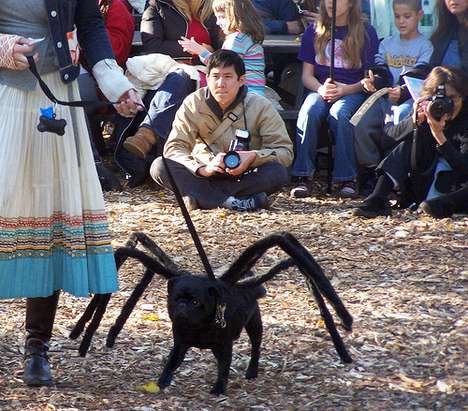
Gus Shows off His Handmade Pug-Spider Halloween Costume
Sandie Samuells made a pug-spider Halloween costume for her little black pug dog named Gus. Gus has since worn his costume when he is out walking and at several events. It isn’t every day people see pug-spider so there have been plenty of photo opportunities. Lucky for us, Sandie took advantage of them.
I contacted Sandie for permission to use her Flickr photos and asked if she could tell me a little about the costume. Here’s what she said, “Since he is a black pug, I thought it would be cute to dress Gus as a tarantula. I found a spider ornament (sold as a home decoration) that had these long, furry pipe cleaner legs and I used those to make the legs of the costume. I used black craft fur and cut out a dog “coat” using one of Gus’ jackets as a pattern. A glue gun to attach the legs, some velcro to close the coat and voila.

The most important ingredient here is a very patient pug! Once he has the costume on, Gus doesn’t even know why people are staring at him! In fact, sometimes he gets stuck because he doesn’t realize how wide he is and tries to squeeze through ‘normal’ width places.”

Other inspired to make their own dogs’ Halloween costumes, will be hard-pressed to do better than Gus’ scary pug-spider garb.


Wednesday, October 27, 2010

Spectacular Unknown Species Discovered in Amazon

NAGOYA, Japan (AFP) – Spectacular species previously unknown to the outside world are being discovered in the Amazon rainforest at a rate of one every three days, environment group WWF said in a report published Tuesday.
An anaconda as long as a limousine, a giant catfish that eats monkeys, a blue fanged spider and poisoned dart frogs are among the 1,220 animals and plants to have been found from 1999 to 2009, according to the study.
The report was released on the sidelines of a United Nations summit in Japan that is being held to try to stem the mass extinction of species around the world, and the WWF said it highlighted why protecting the Amazon was so vital.
"This report clearly shows the incredible, amazing diversity of life in the Amazon," Francisco Ruiz, head of WWF's Living Amazon Initiative, told reporters at the launch.


Ranitomeya amazonica

"Ranitomeya amazonica", a frog with an incredible burst of flames on its head, and contrasting water-patterned legs. Spectacular species previously unknown to the outside world are being discovered in the Amazon rainforest at a rate of one every three days, environment group WWF said in a report

Apistogramma baenschi,

'Apistogramma baenschi,' a new fish species is seen here. New species previously unknown to the outside world are being discovered in the Amazon rainforest at a rate of one every three days, environment group WWF said in a report

Ephebopus cyanognathus,

'Ephebopus cyanognathus,' a new spider species is seen here. New species previously unknown to the outside world are being discovered in the Amazon rainforest at a rate of one every three days, environment group WWF said in a report.

Nymphargus wileyi,

'Nymphargus wileyi,' a new frog species is seen here. New species previously unknown to the outside world are being discovered in the Amazon rainforest at a rate of one every three days, environment group WWF said in a report.

Anaconda boliviana,

'Anaconda boliviana (Eunectes beniensis),' a new snake species is seen here. New species previously unknown to the outside world are being discovered in the Amazon rainforest at a rate of one every three days, environment group WWF said in a report.

Anolis cuscoensis,

'Anolis cuscoensis,' a new lizard species is seen here. New species previously unknown to the outside world are being discovered in the Amazon rainforest at a rate of one every three days, environment group WWF said in a report.

Pyrilia aurantiocephala i,

'Pyrilia aurantiocephala i,' a new bird species is seen here. New species previously unknown to the outside world are being discovered in the Amazon rainforest at a rate of one every three days, environment group WWF said in a report.

Inia boliviensis, '' pictured in Bolivia

"Inia boliviensis," pictured in Bolivia. Spectacular species previously unknown to the outside world are being discovered in the Amazon rainforest at a rate of one every three days, environment group WWF said in a report.

First new anaconda species identified

The first new anaconda species identified since 1936, the "Eunectes beniensis". Spectacular species previously unknown to the outside world are being discovered in the Amazon rainforest at a rate of one every three days, environment group WWF said in a report.

View of deforested area

A view of a deforested area on the border of Xingu river in the Amazon rainforest, northern Brazil in 2005. Japan plans to give about 60 million dollars to help developing countries protect species and habitats at a UN conference on biodiversity it is hosting.

Photo provided by Conservation International

A Photo provided by Conservation International shows a newly discovered frog in Papua New Guinea. It was discovered during Conservation International's two Rapid Assessment Program surveys. The frog is a striking, yellow-spotted species that belongs to a group of frogs that lay their eggs on land or in the trees where they hatch directly into little froglets, and they have no tadpole stage
A photo provided by Conservation International shows a newly discovered katydid in Papua New Guinea in the Muller Range mountains, Rapid Assessment Program scientists Piotr Naskrecki and David Rentz found at least 20 new species. This pink-eyed Caedicia probably feeds on flowers of the forest’s tall trees.
A photo provided by Conservation International shows a newly discovered frog in Papua New Guinea. It is a member of the Litoria genimaculata group and has extremely variable colour patterns and distinct yellow spots in the groin. It was found in the lush foliage along small rain forest streams in the Muller Range mountains

Species of montane mouse documented

A species of montane mouse documented during the Rapid Assessment Program biodiversity survey in the Nakanai Mountains, Papua New Guinea in April 2009. The beautiful long-tailed mouse was captured at a high elevation site (1,590m above sea level). Scientists on October 6, 2010 unveiled a spectacular array of more than 200 new species discovered in the Pacific highlands of Papua New Guinea

Thursday, October 7, 2010

Really Big Things You Can't Miss

Wherever you go in this country, there’s likely to be something big you can visit along the way. And by big we mean something that is – or claims to be – “the world’s largest ...” Some turn out to be civic efforts to get some attention, but many are testaments to a town’s better times gone by. Feel we've missed something big on this list?
World’s Largest Bottle of Ketchup – Collinsville, Ill.

This 70-foot tall, bottle-shaped water tower sits on 100-foot-tall steel legs and was built in 1949 to advertise the local bottling plant making Brooks Catsup. In the early 1990s, long after the community’s ketchup-making was capped, a local preservation group saved the bottle from demolition and now holds a World’s Largest Catsup Bottle Festival each July."

Big Things: World's Largest Frying Pan
Rose Hill, N.C., boasts a giant pan 15 feet in diameter, but this 10-by-20-foot cast-iron beauty is older and bigger. Forged in the early 1940s, the pan was first used to fry the world’s largest clam fritter. To help out, local girls greased the pan by skating around inside it on large slabs of butter.

Big Things: World's Largest Penny
In 1953, local citizens and perfect strangers from around the country gave their two cents, and more, when Dr. Kate Newcomb asked for help getting a hospital built in this northern Wisconsin town. In response, local schoolchildren began a campaign to collect 1 million pennies. Their success (1.7 million pennies raised) and Newcomb’s dedication (she was known for making house calls on snowshoes if needed) are commemorated with a 17,000-pound concrete 1953 penny 10 feet in diameter and 18 inches thick.

Big Things: Giant Duck
Built in 1931 by one of the many duck farmers who used to operate on Long Island, this 20-foot-tall, 30-foot-long duck was for many years a shop that sold, you guessed it, eggs and Long Island duck. Most duck farms are gone, but the big plucky duck is still here and is listed on the National Register of Historic Places.

Big Things: World's Largest Spinach Can
Your kids may not care for it, but Alma loves spinach. The self-proclaimed “Spinach Capital of the World” has a spinach canning plant, a bronze statue of Popeye, an annual Spinach Festival and, overlooking the town, a giant water tower painted to look like a can of Popeye brand spinach.

Big Things: Souvenir Plate
Created by Erika Nelson, an artist who travels the country displaying her tiny versions of some of the world’s largest things, this souvenir travel plate is 14 feet in diameter and made from two decommissioned fiberglass satellite dishes, nestled one inside the other. “One of the local scenes depicted is the burning of the fields that takes place each fall,” Nelson says. “It’s very dramatic and scary for a first-time viewer.”


Big Things: World's Largest Egg
Mentone, now home to two of Indiana’s egg-producing companies, has been known as the “Egg Basket of the Midwest” since the turn of the 19th century, when trains would stop in town to pick up eggs bound for Chicago and East Coast markets. To honor its egg-citing history, it built the world’s largest egg – 10 feet tall and 3,000 pounds of concrete and steel – to display in the center of town.

Big Things: Largest Eight Ball
For years Tipton, Mo., was headquarters for a home-grown company that became one of the country’s largest manufacturers of pool tables. The billiards business left town in the 1980s, but this water tower decorated as the world’s largest eight ball remains.

Big Things: World's Largest Holstein Cow
Salem Sue, the world’s largest Holstein cow statue, was built to honor the area’s dairymen and celebrate the history of this dairy-dependent community. Sue stands 38 feet tall and 50 feet long, and even though it’s hollow and made of fiberglass, it weighs in at 12,000 pounds.

Big Things: World's Largest Loon
Looking for loons? Minnesota’s state bird is the loon, and at least two towns claim to be the home of the state’s largest loons. The town of Virginia has a 20-foot fiberglass floating loon decoy. Vergas, the self-proclaimed “Home of the Loon” has had a 20 foot-tall sculpture of a loon since the 1960s.

Big Things: Albert the Bull
Albert the Bull holds the title as the world’s largest bull statue and is Audubon’s tribute to its cattle-industry heritage. The 30-foot-tall, 45-ton concrete statue of a Hereford has a horn span of 15 feet and is lighted at night, welcoming travelers passing by. “There’s even a recording out there that will tell you the whole story of how Albert got made,” says a caretaker at the nearby Albert the Bull Campground.

Big Things: Lucy the Elephant
This six-story, 90-ton elephant named Lucy was built in 1881 as an attraction to lure potential real-estate investors to a patch of undeveloped property on the southern New Jersey seashore. Since then, Lucy has served as everything from a summer home to a tavern. The wooden elephant with metal skin survived hurricanes, a fire and years of abandonment before being rescued and relocated in 1970. It was eventually refurbished and reopened as a tourist attraction.

Big Things: Big Brutus
The world’s largest electric coal shovel stands 16 stories high (160 feet) and weighs 11 million pounds. From 1963 until 1974, this one-of-a kind, black and orange behemoth worked seven days a week, 24 hours a day moving dirt and rocks aside so coal could be mined. When it came time to retire Big Brutus, operators backed it out of the coal pits, parked it and removed its engines. Today, the giant shovel is the centerpiece of a museum dedicated to miners and mining history.

Big Things: The Big Lemon
In the early 1900s, Lemon Grove was known for its lemon and orange groves, but today the town is a suburb of San Diego with barely an orchard left. “Still,” says “World’s Largest” co-producer Amy C. Elliot, “this big lemon statue is still there. It’s been repainted over the years and still remains a symbol of the town, even though that’s not what they’re about anymore.”

Share

Twitter Delicious Facebook Digg Stumbleupon Favorites More